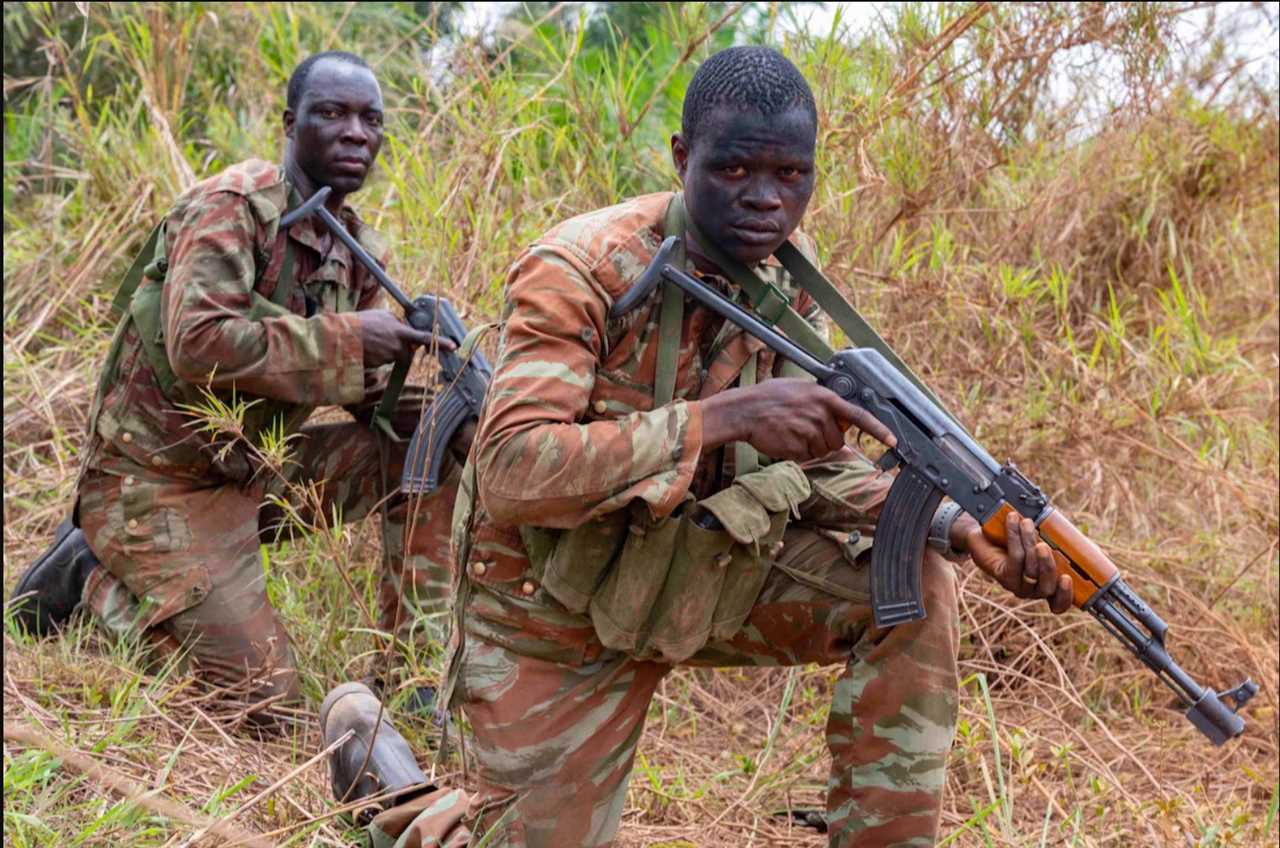
The United States conducts counterterrorism operations and training alongside numerous allied governments in Africa. At the same time, Iran is funding wars and terrorist organizations across the continent. Photo courtesy of the Secretary of the Air Force for International Affairs.
The April 2026 arrest of Shamim Mafi at Los Angeles International Airport, charged with brokering a $72.5 million Iranian arms deal to Sudan, exposed more than a single transaction. It opened a window onto a continental network the IRGC has been building for four decades, one that now spans North Africa, the Horn, the Sahel, and southern Africa.
In North Africa, the IRGC has applied its proxy model to the Western Sahara conflict. The Polisario Front, formally the Popular Front for the Liberation of Saguia el-Hamra and Río de Oro, is an Algerian-backed separatist movement founded in 1973. The group claims sovereignty over Western Sahara, a territory Morocco has administered since Spain’s withdrawal in 1975. A UN-brokered ceasefire in 1991 ended open guerrilla warfare, but a promised independence referendum was never held.
Today, the Polisario controls roughly 20 percent of the territory from desert camps in Tindouf, Algeria. It operates a self-declared government-in-exile called the Sahrawi Arab Democratic Republic. The United States recognized Western Sahara as Moroccan territory in 2020.
Iran’s entry transformed this Cold War-era territorial dispute into a live proxy conflict. In 2018, Moroccan Foreign Minister Nasser Bourita accused Iran and Hezbollah of training and arming Polisario fighters through the Iranian embassy in Algeria. He stated that Hezbollah had supplied the group with SAM-9, SAM-11, and Strela surface-to-air missiles. The allegations prompted Morocco to sever diplomatic ties with Tehran.
The relationship has since deepened into direct military deployment. Regional and European security officials told the Washington Post that Iran trained hundreds of Polisario fighters who were later detained by Syria’s new security forces after fighting alongside the Assad regime. Among those detained were an Algerian army general and approximately 500 soldiers. Syrian Interim President Ahmed al-Sharaa rejected Algerian requests for their release, stating that all captured fighters would face prosecution for war crimes and crimes against civilians.
Fahed al-Masri, head of Syria’s National Salvation Front, told Yedioth Ahronoth that 200 Polisario fighters trained by Iran had been deployed to sensitive military positions near the Israeli border. In 2022, Polisario Interior Minister Omar Mansour publicly disclosed that fighters were training in the assembly and operation of armed drones. Open-source weapons analysts also confirmed that imagery posted on Polisario social media channels showed Iranian-type munitions.
The episode exposed an operational triangle linking Algiers, the Tindouf camps, and the Syrian front. It confirmed that the Polisario functions not merely as a separatist movement, but as a deployable component of Iran’s Axis of Resistance. Senator Ted Cruz introduced legislation in March 2026 to designate the group as a Foreign Terrorist Organization. Cruz stated that Iran was attempting to turn the Polisario into “the Houthis of West Africa.”
IRGC support for Polisario fighters, along with the growing flow of advanced weapons, risks transforming a regional territorial dispute into another frontline of the Axis of Resistance.
In West Africa, Iran’s ideological and IRGC influence in Nigeria traces back to cleric Ibrahim al-Zakzaky, who formed the Islamic Movement of Nigeria (IMN) after visiting Iran in 1980. The IMN is a Shia Muslim movement modeled on Iran’s theocratic governance system and was banned by the Nigerian government in 2019.
Analysts describe the IRGC’s use of al-Zakzaky as “the nucleus for building a Hezbollah-style organizational structure in Nigeria.” The model centers on a cleric with supreme authority, religious activism concealing a paramilitary wing, and the recruitment of disaffected youth.
Al-Zakzaky, who met with Khamenei in October 2024, has long promoted educational exchanges that funneled students into Al-Mustafa University, an institution linked to the Quds Force. Using Iranian funding, the IMN operates a network of Islamic centers and more than 300 schools across Nigeria, providing free education that critics describe as indoctrination.
As of 2025, Al-Mustafa University maintained locations in at least 17 African nations, ranging from Senegal to Tanzania and South Africa. The network gives Tehran an ideological footprint that precedes and outlasts any single arms shipment.
The National Council of Resistance of Iran (NCRI), the principal Iranian opposition body in exile, warned in 2021 that the IRGC had established training centers for IMN militants in Kano and Sokoto as part of Tehran’s strategy to expand influence throughout West Africa. The movement mobilizes tens of thousands of members for political demonstrations, many featuring the burning of American and Israeli flags alongside veneration of Ruhollah Khomeini and Ali Khamenei.
As recently as March 2025, five IMN members and one security-force member were killed in clashes in Abuja during Quds Day demonstrations.
Quds Day is observed annually on the last Friday of Ramadan. Ayatollah Khomeini established it in 1979 as a global expression of solidarity with Palestinians and opposition to Israel. Since then, it has become one of the primary vehicles used by the Islamic Revolutionary Guard Corps (IRGC) Quds Force to mobilize proxy movements worldwide.
The Quds Force is the IRGC’s external operations branch. It is responsible for training, arming, and directing proxy militias across the Middle East and Africa on behalf of the Iranian regime. Police claimed the demonstrators were armed.
Since 2020, military officers have seized power across West Africa in Mali, Burkina Faso, and Niger. The juntas ousted elected governments, expelled French and American forces, and formed a mutual-defense pact called the Alliance of Sahel States.
Isolated from Western partners and desperate for security assistance and revenue, the regimes began seeking alternatives unconstrained by human-rights conditions, and Iran obliged. In exchange for yellowcake uranium, Iran promised Niger’s junta economic aid, agricultural assistance, and weapons, including drones and surface-to-air missiles.
Iran reached a $56 million agreement with Niger to purchase 300 tons of yellowcake uranium. The deal was confirmed by Iran International and corroborated by Le Monde. In exchange, Tehran reportedly provided drones and surface-to-air missiles.
In Mali, Mohajer-6 and Shahed-series drones, surveillance systems, and technical advisors were sent to the juntas in Niamey and Bamako in exchange for yellowcake uranium and artisanal gold. The deals provide Tehran with raw material for its nuclear program while embedding IRGC technical staff inside Sahel security forces.
Since 2021, Iran has sent Ababil-3 and Mohajer-6 drones to Ethiopia, Sudan, and Western Sahara, establishing a precedent for additional Sahel shipments. Gold from Sudanese conflict mining and Sahel artisanal operations reportedly helps fund the network directly, moving through Red Sea routes before entering official channels.
In the Horn of Africa, Iranian arms have for years reached Somalia, where they are reportedly sold to violent extremist groups, including al-Shabaab and the Islamic State. At the same time, Iran has used Somalia as a channel for funneling weapons to the Houthi militia since around 2016.
A UN Panel of Experts report presented to the Security Council in October 2025 found that Houthi and al-Shabaab cooperation had intensified to unprecedented levels. The relationship reportedly involved weapons smuggling, military training, and the exchange of logistical support.
In 2025, the United States interdicted advanced conventional weapons moving from Yemen to Somalia, possibly including surface-to-air missile components.
IRGC naval forces have also reportedly used Eritrean ports for covert docking, intelligence gathering, and logistical support. In the mid-2000s, Quds Force personnel in Eritrea allegedly supported al-Shabaab’s insurgency against Somalia’s central government.
In southern Africa, Iran has found diplomatic cover through BRICS. In January 2026, Iranian, Chinese, Russian, and South African warships gathered in South African waters for the BRICS-Plus naval exercise “Will for Peace 2026,” led by China and hosted at Simon’s Town Naval Base.
A South African defense analyst warned that “adding Iran, a pariah state still under United Nations sanctions and an associated arms embargo, has given South Africa a huge foreign-policy headache at a time it can least afford one.” The United States also threatened trade consequences under AGOA.
Iran’s participation, which was disputed internally within the South African government, nonetheless demonstrated Tehran’s ability to project naval power to the Cape of Good Hope and normalize its military partnerships within the Global South framework.
Financing ties the entire network together. According to a 2025 American Foreign Policy Council paper, approximately 30 percent of profits from cocaine transiting the African continent en route to Western nations can be tied back to Hezbollah. The group also leverages West Africa’s large Lebanese diaspora for arms trafficking and smuggling operations.
Barter arrangements, such as drones exchanged for uranium or training exchanged for gold, help shield field operations from Treasury sanctions even when Iran’s central bank is frozen.
The post Iran Is Arming Africa’s Wars and Terrorist Organizations appeared first on The Gateway Pundit.
https://www.thegatewaypundit.com/2026/05/iran-is-arming-africas-wars-terrorist-organizations/
Read More